Friday, March 4, 2011

Rome

Put your Roman togas on (by the way, they are remnants borrowed from the Etruscans!) as this will be a long post!

Fred came back to Italy for the boys’ “ski” break last week and we set out by train for Rome (just under two hours on the Eurostar) the next morning…spent three days in Rome and then flew EasyJet  (cheaper than the train these days) to Paris for three days and then back to Florence.   Rome was magnificent, much moreso than I’d imagined.  Rome and Florence are really worlds apart and were really “worlds apart,” different kingdoms really, until unification of Italy in 1860.  Florence was a republic for much of its history and was far enough away from the Vatican and not on the via Francigena (one of the main medieval pilgrimage roads between Rome and northern Europe…all roads lead to Rome) highway.  
We took a taxi through Rome to our hotel and the first thing we all noticed was the bright white of the travertine stone of many of the buildings.  I’m talking bright white!  Our taxi deposited us in Piazza della Rotonda where we’d booked a hotel (Albergo del Senato—a wonderful old hotel with a marble staircase, many rooms with little terraces facing the back alleys and a really nice staff) right next door to the Pantheon which is Rome’s oldest building and considered its greatest architectural achievement.   The Pantheon (pre-Christianity “all gods” but later co-opted into a Christian church at the end of the Roman empire about 608 AD) is the best preserved building in Rome…2000 years old, completely intact.  The pictures below don’t do it justice….all I will say is that I can see how Brunelleschi was inspired by the dome of the Pantheon in building the dome for Santa Maria del Fiore in Florence…and also how we was inspired by its perfect proportions…the diameter of the Pantheon’s dome is equal to its height in the center.  It is surreal being inside: light is provided by its circular oculus above (a 9 meter opening in the dome) and all around the marble floor are these small holes that drain the rain.  We were able to walk from the hotel over to the Trajan Forum, the Roman Forum, the Vittorio Emmanuel II memorial and the Colosseum.  The boys recognized a lot more of this than I did at first take since they’ve been studying Latin!  It’s so strange to see cars buzzing around on modern roads juxtaposed against large columns jutting out from the ruins.  And realizing, after walking through the Jewish ghetto and other areas, that buildings were constructed of salvaged and plundered “re-cycled” stone from the Roman ruins. People would just go up to the Colosseum and other ruins and hack out what they needed to build new structures.  In front of the Colosseum there were fake gladiators who gently accost you to take pictures with them and then ask for money.
Per Owens’ advice, we took a private tour of the Vatican and were so glad we did!  We didn’t have to wait in a long line with the other Pilgrims to get into Vatican City…went right through the queue with our guide who took us through the Vatican Museums. Too marvelous in the museums…particularly the ceiling of the map room and all the collected ancient statuary.  I was almost finished at that point reading “The Agony and the Ecstasy” about Michelangelo’s life…so seeing the culmination of about 7 years of his life work on the Sistine Chapel’s ceiling and front wall was amazing.  Thinking of him lying on his back up on scaffolding painting frescoes of the Creation story on the ceiling with paint and lime dripping into his eyes.  On the Last Judgment wall, our guide also pointed out one of the guys who gave Michelangelo troubles…he was painted with a serpent wrapped around his body and just about to ingest his privates.  Or how Michelangelo inserted a painting of his own face on the “hide” of St. Bartholomew after he (St. Bartholeomew) was flayed alive. So interesting also to see some of the coverings later put over the private parts when Pope Paul IV of Inquisition fame wanted the frescoes whitewashed over because they were heretical.  As an aside, it has been enlightening to read the history of the popes and think of how they characterize the pendulum of human behavior over the ages….the Medici popes with their orgies and excesses followed by Pope Paul IV who put the iron clamps on with the Inquisition.  Rome proper has over 1000 churches…it was the site of quite a bit of martyrdom, too, starting with St. Peter, who was crucified upside down (have seen that on a number of frescoes, probably best so far at the Brancacci Chapel in Florence) yet many of the popes seemed just as barbarous, if not more, than the Romans were.
We saw the marks on the floor of the Sistine Chapel where the stove is put during Conclave when they decide on the New Pope (wet wheat was originally burned for black smoke, and dry wheat for white smoke).  We went down the Papal steps, over into the grottos (catacombs) under St. Peter’s where all the Popes are buried.  Strange to walk past John Paul II’s tomb with all the little white notes on it and people praying beside it, and then round the corner and see the covering over the entrance to the crypt for St. Peter the apostle, right under the main altar of St. Peter’s basilica followed by walking into St. Peter’s basilica itself...the largest church in the world.  As another aside, apparently Pope John Paul II is quite well preserved and they are going to haul him up into the basilica where you can view him in a glass case like Lenin. You glean some appreciation of St Peter’s size compared with other great cathedrals of the world since there are  markings on the nave's floor comparing where the other churches of the world would be if they were fit inside St. Peter’s.  It would seem that part of  this was about bigger and better…the Popes just conquering and taxing to raise funds for bigger and better.   It casts even more of a shadow on Catholicism for me to see the excesses…however, the magnificence of Michelangelo’s works commissioned by so many cardinals and popes over his 89 year lifetime is a tribute to the sustaining power of art, especially his magnificent marble Pieta just inside and to the right of the main entrance. 
We walked to Navona Square (by the way the fountain is way too shallow to have drowned the fourth Preferiti in “Angels and Demons”….we decided to watch the movie again after seeing the Vatican), Trevi Fountain at night (had to see that in person after the scene in "La Dolce Vita"), and on to the Spanish steps to find the house where Keats died and also where the boys bought green laser pointers so that they could later shine on buildings in Rome at night.  They want to go back, we want to go back after we finish digesting this trip!  Speaking of digesting, I really can’t tell you a thing about food there…it seemed that eating was secondary to exploring!


Inside the Pantheon (built 2000 years ago as a pagan temple to all gods and later co-opted into a sacred structure)

oculus of Pantheon

Pantheon from our hotel

Ryan and Evan in front of Colosseum with fake Gladiators

Fred, Ryan and Evan in front of Trajan ruins

Colosseum

Roman Forum

Trajan ruins
Ceiling in Vatican Museum
Boys walking down Papal steps outside Sistine Chapel
St. Peter's Basilica
Famous huge Pine cone in Vatican Courtyard.  It is one of Papal symbols (yet this was said to be made in 1st or 2nd century by Romans as a pagan symbol of fertility.  Another explanation is that the pine cone requires a strong heart to withstand the fire required to break it open and spread its seeds and thus is a symbol of faith.) One of the other recurring symbols of  the Vatican are the gold and silver crossed keys which are the "keys to the kingdom of heaven"

Roman Empire at its apogee  


Monument to Vittorio Emmanuel II (love that bright white travertine stone)

St. Peter's Basilica dome

one of over 1000 churches in Rome

Altar in St. Peter's Basilica (oculus is made of alabaster)

Bridge of the Angels over Tiber River

Castel San Angelo (you can't see but there's a walkway that connects it to the Vatican--this is where the popes hide out when things get a little rough.  It has also served as a prison)


Pope's gown and triple crown (retired now because crown too heavy!) inside St. Peter's Basilica

Sopra Minerva Church right by Pantheon.  Beloved "Elefanto" and Egyptian obelisk out front.  This church has St. Catherine of Siena's body inside under altar (her head is under altar at Duomo in Siena).


Swiss guard at Vatican under Pope's residence


Thursday, February 17, 2011

Volterra

The guidebooks say to visit the Tuscan hill town Volterra in winter if possible to see colors of “Pleistocene era” clay coming through. It is a barren landscape, stark, with the umbers and ochres coming through the winter grass. I particularly liked the huge red sculptured circle that looks like a Star Trek portal right before you arrive in Volterra. The art history teacher in Florence spoke about sfumato, one of the modes of Renaissance painting where the landscape “evaporates like smoke.”  Certainly, in the fog Monday the landscape evaporated like smoke.  Volterra was one of 12 cities of Etruria Propria and one of the most prominent. (The word Tuscany is derived from “Etruria”).  It was subdued by Florence in 1361 and again in 1472 by Lorenzo the Magnificent. Currently, some parts of the Twilight series' movies have been filmed there and apparently the kids show up in the town square dressed up in red capes!
  
Its Palazzo dei Priori with its tower is the oldest town hall in Tuscany.  I loved its baptistery (of course octogonal, eight sides for infinity).  The holy water stoup is made from an Etruscan stone funerary urn.  Wonderful how new religions and cultures co-opt the previous…Christianity using an Etruscan urn for a baptismal font.  I also saw that the very long thin figures of bronze made by the Etruscans were very Giacometti-like….indeed now I see how Giacometti was influenced by the Etruscans particularly by the sculpture entitled “Shadow of the Evening” (Ombre della Sera), a stretched out figure of bronze found in 1870 by a farmer working the soil around Volterra.  Not knowing what he found, he used it as a fire poker for years until someone recognized it was a masterpiece of Etruscan art.  There were reproductions of this piece in several shops around town. Though we did not get into the Museo Etrusco Guarnacci, I would like to go back as this has the largest collection of Etruscan art. In fact, definitely going back to Volterra as I went with some new friends here and the boys and Fred will definitely want to see this place!

We visited first the Parco Archeologico, which was enclosed by fence and is the site of the Etruscan and Roman acropolis with bases of temples from 2nd century as well as Roman cisterns and reservoirs.  In the distance is the massive Fortezza, or Rocca Vecchia (old fortress).   It has a semicircular tower and is still a prison.  The prison has a renowned theater group who give regular performances!   On the other side of the city is the Roman theater built at the end of the 1st century and one of the best preserved in Italy, the most impressive part being the scena with two tiers of Corinthian columns partially intact as well as parts of the Roman baths and part of the cavea (which were the subterranean cells in which wild animals were confined 
before the combats in the Roman arena or amphitheatre.)

What’s interesting as you drive around the area are natural precipices which are formed by the erosion of the clay.  Almost all the buildings in Volterra are constructed from panchina, a kind of limestone which is the matrix of alabaster, found there in abundance.  Volterra is known for craftsmen working alabaster and I was able to find my family yet again in Volterra with the old Rossi alabaster craft shop!  (I am finding my family of “plural reds” (Rossi) everywhere and it is so reassuring to know how popular we once were!) There are a number of alabaster shops…with everything you can imagine made of alabaster including kitsch.  There are only three colors occurring in nature…grey, clear white and a brownish color and in one of the stores they explained that it depends upon the depth underground one goes as to which color you get.  Any other color is the result of dyeing (see below).  Alabaster fruit is more sustainable than plastic, right?? Some stores stipulate that their alabaster is pure and not a compound of crushed alabaster and resin.  I took some pictures of “old pictures” on the walls of one the workshops of craftsmen working with alabaster. We went through several shops and I found some wonderful alabaster eggs, both in natural color and dyed.  Alabaster is rather soft as stone goes, and is shaped with tools that also work wood.  There was everything from beautiful sculpted animals to jewelry.  Clear white alabaster has a history of being used for church windows, too.  I also loved the hand-crafted objects made of olive wood which has a beautiful grain pattern---I bought some spoons and ladles and, of course eggs made of both alabaster and olive wood.  Also, Volterra is one of the areas alum was first mined in Italy (helped bind dyes to wool).

I am not sure but think I may have a picture of some of the “children’s windows.”  Apparently in some buildings, lower, smaller windows were made for children to look out of so they wouldn’t fall out of the larger windows!  Kind of like that added touch.  Etruscans were a more matrifocal-oriented society…perhaps that explains why there might be “children’s windows” ...even long after the Etruscans were gone, some of their spirit carried on
Rocca Vecchia (old Fortress) now a prison

Tuscan portal?

View from Volterra

Ruins of Volterra's Roman ampitheater

Volterra baptistery with Etruscan urn for water stoup inside

Alabaster sculptures 

Picture of an old picture of an alabaster craftsman

Alabaster fruit!


Parco Archeologica -part of Roman acropolis with cistersn, baths and reservoirs-excavated in 1950s

Volterra's Duomo inside

View of Volterra from Parco Archeologica (in a rare hour of sunshine)

more long lost relatives in Italy!
?children's windows so kids could look out windows without falling out

Steps in ampitheater down to caveam where the wild animals were kept!

Sunday, February 13, 2011

Evan's post 2-13-11

Ciao ragazzi! This is Evan as you can probably tell from my first two words. Some updates from Florence: We  have a week left of school before ski break! We went to Lucca the other day. Lucca is a small city about an hour from Florence surrounded by humongous dirt walls and inside there are a bunch of houses. I thought it would be really boring but then we went in the square and saw some super cool stores. In one of the buildings they had underground Roman baths that were 2000 years old. On one of the stone walls, there were a bunch of carvings of people doing stuff that was supposed to tell the story of what they did each month, like pig sticking ( they impale a pig with a stick and made bacon), olive harvesting, wine making. One of the guys had his head cut off, which was pretty weird ;). There were also some pretty awesome stores. One of the stores had Katanas, chain mail, magazines, and crossbows, which was pretty sweet. Unfortunately, I did not have any money, but my kind brother Ryan lent me 10 euros and I bought an airsoft gun with a laser pointer. During the chocolate festival, I shine my laser out the window in front of people and they look up surprised and jump up. I find this very funny. Also we have had some bus problems the past few weeks. A few days ago I went on the bus with my friend without the ticket and I told him we should get off because there was a guy that looked like he was one of the guys that checked for tickets. We didn't get off, but sure enough he came and gave us a ticket, a fine of 50 euros (ouch). Things are going more smoothly, and I think I have adjusted fully. Ciao!


Ryan and I in front of gate to Lucca


San Michele Church in Lucca

Underground Roman baths (under Baptistery in Lucca)

A square in Lucca

Some of the 12 seasons on the front of Duomo in Lucca

Me running toward Lucca's walls. The walls are about 30 feet high and 100 feet wide and you can walk or bike on them.    Where I am there used to be a 100 foot wide moat.


Friday, February 11, 2011

a little piece on Food

First, I wanted to say I'm still trying to really figure out the difference between an osteria, trattoria and pizzicheria.  I know the difference between a cafe and a bar.  I learned quickly at the bar where I went for a tea one day that if you sit down at the little tables, the tea price automatically goes from 2 Euro to 5 Euro! That's why you swallow your coffee, espresso, etc. standing up.

Some absolutely wonderful trattorie I've tried in our area (Santa Croce): right next to San Ambroge market (for the obvious reasons!) are Cibreo's Trattoria, cafe and restaurant.  I have not been to the restaurant but have been told to just eat at the Trattoria and cafe as it's the same excellent food but cheaper and indeed one day when eating at the cafe, I saw the waiters crossing the street from Cibreo Restaurant with the hot dishes in hand (I have had both minestrone soup and eggplant dishes there along with a type of grilled onion that is out of this world).  I also love Baldovino's (both a restaurant with Neopolitan style pizza and a wonderful little trattoria right next door) right behind Santa Croce church as well as the new Trattoria, Lulu's over by San Lorenzo.  Right next to our palazzo entrance is the ristorante Boccadama which serves wonderful Tuscan fare including ribollita soup (a thick soup with bread in it!) as well as minestrone and Tuscan sausage and cinghiale (wild boar--note they don't shoot the boar from a helicopter like they do in Texas! And from what I hear, the wild boar has to be washed multiple times in vinegar water the day before you cook it and I think I'll just pass on that one). The best time to eat lunch (pranzo) is from 1-3 and if you are traveling, you had better eat well because most of the ristoranti don't open again until 7 p.m. The boys have found the gelateria Vivoli one street over on via Isola delle Stinche (isn't that a name) ...although it is said this is one of the best gelateria, the boys love the Gelateria Nero on via dei Nero (If I ate as much gelato as they did, I wouldn't be able to make it out of the apartment!).  Ryan has become a fan of stracchiatore (wedding cake gelato) and Evan loves the fragola (strawberry).  The Italians are passionate about food and drink... fresh ingredients, how it is made, how it is eaten and its presentation...they have a reverence for food, a healthy love affair with food.  The camerieri (waiters) have told us that we have to drown our food with things--olive oil, ketchup, etc! I have been thinking that perhaps if we revered food as much as they do, we wouldn't have so many problems with overeating and wrong food combining.  Unfortunately (purtroppo, c'e male!), I am just not much of a wine drinker so I can't report on that, however, I do really like a touch of "digestivo" (after-dinner liqueurs) Mirto de Sardegno and Vecchio Amara del Capo, and not just for the absolutely adorable tiny glasses you drink them from!

For instance, in the cooking class I've been taking, Veronica admonished us never to put cheese and fish together in a meal and I realized that I'd learned the same thing in Ayurvedic teachings on food mixing so there is some foundation and logic to all of this. She also says you can only use white pepper and white wine with fish...  I'm adding a few pictures from my recent cooking class below.  For the first time in my life, I ate cuttlefish (sepie) the other and it was wonderful, if not a new and unusual taste.


At La Quercia after our meal was made:
Colombia, U.S., Australia and Italy represented!
 
La Quercia cooking studio in Impruneta

ingredients


Contorno di Scarole all Mediterranea (escarole dish with garlic,
olive oil, anchovie, olives capers and pine nuts)
Absolutely divine and I will share the recipe


Calamarata (the pasta is called camarata because it is
shaped like calamari!) This dish has calamari and cuttlefish
 in it with olives, artichokes and capers.


Cipolle Bianche al Forno (white onions stuffed
with pecorinocheese and bread crumbs--can use substitutes)
and the leftover filling made into a fritatta

Calamata (ok had to show it on the plate)


Strudel Nonna Olga!


B.C. (before cooking)


Thursday, February 10, 2011

Renee post 2-10-11

 
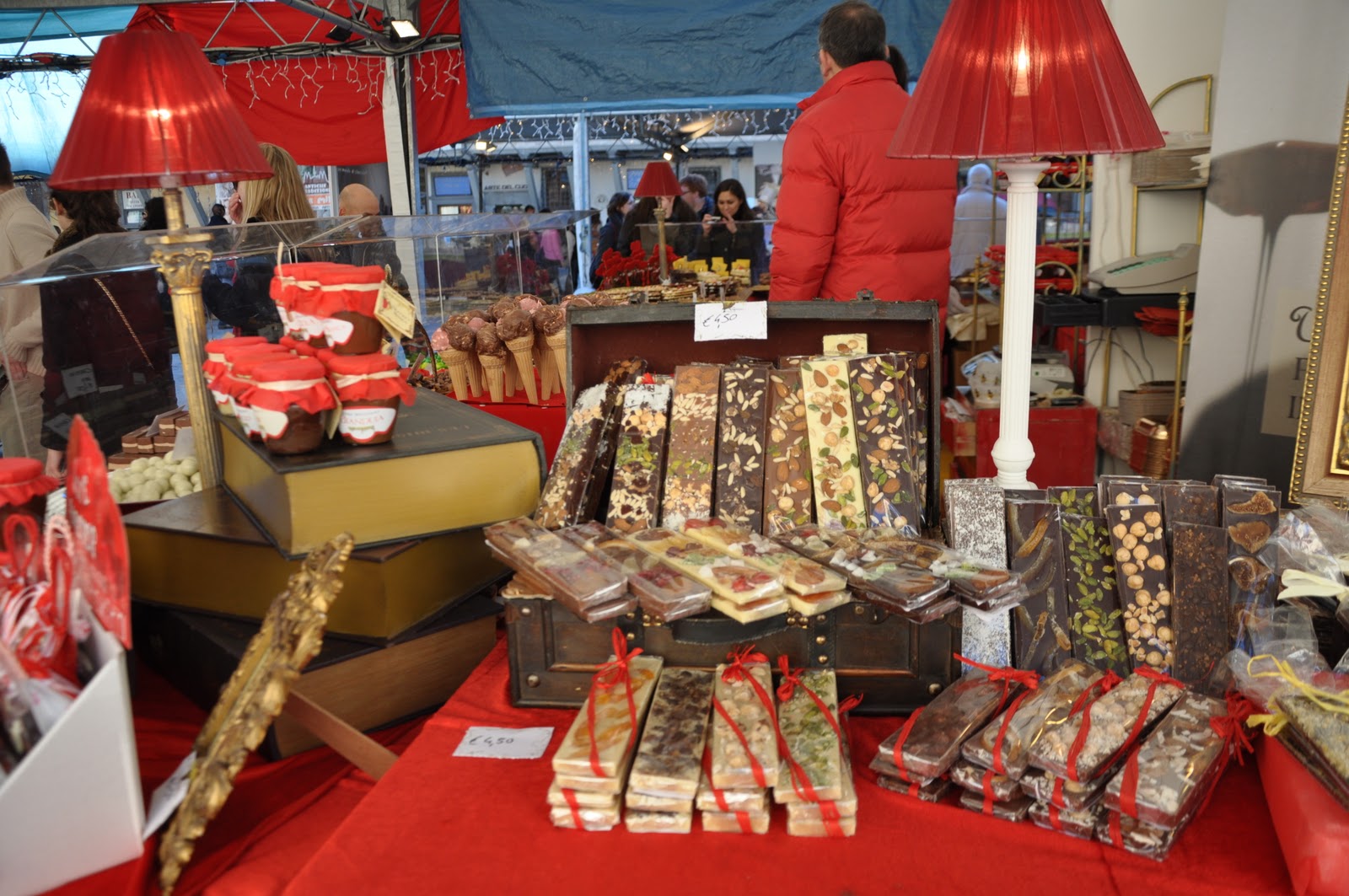
This is a hodge-podge posting of some of the things I've noticed in Florence recently. We are nearing the end of the Chocolate (Cioccolata) Festival.  It is so strange to look out the windows (large casement windows with rounded tops and ancient latches) onto the piazza and see all the tents and people milling about.  The boys have overdosed on chocolate! They just walked outside the door to get warm nutella crepes.  I think my favorite samples were the violet and cinnamon chocolate.  We loved seeing the trumpeters, flag throwers/wavers and drummers on Saturday in the piazza…some tradition I’ve yet to know the history of. 


Cloisters at San Lorenzo

Laurentian Library at San Lorenzo designed by Michelangelo.  Virgil's Aeneid was originally stored here.

Staircase designed by Michelangelo in the Ricetto (vestibule) to Laurentian library.  It's a bizarre staircase--in the fashion of Mannerism.  The stone is pietra serena.

Michelangelo's Ricetto (vestibule into the Laurentian library at San Lorenzo where the Medici stored their ancient texts)

Morgante, the "Court Dwarf" to Cosimo I Medici (in Boboli Gardens).  The turtle was one of Cosimo's favorites: "Festina lente" =more haste, less speed.  The position of court dwarf was one that was offered by all the important rulers in Europe...as they were ascribed to be lucky charms or healers and collected like other exotic objects.  Over the top, no? 


View of Palazzo Vecchio (the original city council building started in 1299) and made of "pietra forta" (strong stone).  This is viewed from a an upstairs patio at the Uffizi Museum where the railings are made of "pietra serena"
The older buildings in Florence were made of pietra forta and the newer in pietra serena.

Merry-go-round in Piazza Repubblica.  For the record, the piazza was empty on this cold day.  It will be a mob scene here in a few months.

Courtyard of Palazzio Vecchio (old city council building) built in 1400s in Piazza Signoria

Sculpture in Bardini Gardens


I started an intensive Italian language course at the Michelangelo Institute about a five minute walk from the apartment.  It is on via Ghibellina very close to the original Buonarotti house (Michelangelo’s home…he was a stone’s throw from Santa Croce piazza) which is now a small museum.  In any event, I am finishing my second week of the course which runs from 9 a.m. to 1 p.m. each day.  It is spoken almost entirely in Italian: seeing as there are three young women from Guatemala, a young man from China (who speaks only Chinese!), a Swedish man and me!  So, you can’t really explain things in English when the others don’t speak it—everything pretty much has to be in Italian and it’s quite lively.   The Guatemalan girls (just out of high school) keep saying “ciao, brother” to the instructor as his name is Hermano!  Idioms are flying everywhere. Because I hear the language spoken around me constantly (you can imagine doing yoga classes in Italian in a 14th century building...at least I understand the Sanskrit), I have begun to understand bits of it but it is still very hard to speak it and parse it into phrases…thus I decided to take the course since it is mostly all conversational.  After taking the first two weeks straight of the intensive, you can continue to add on weeks up to four months.  Not sure I want to take that much…my brain is hurting right now.
Did I mention bureaucracy here?  The boys have been traveling on the bus using a student bus ticket this month and they were tagged by the “ATAF militia” on the bus the other day for not having a proper student ID validating their “student-hood” even though they showed copies of their passports (nest time don't show the passport, boys...)…the fine was 55 Euros apiece.  I spent quite awhile in the post office trying to pay that one off and it was quite comical my trying to fill out the necessary forms before paying.  People go to the post office to pay their bills here and it is rather a complicated affair with four different types of cashiers and numbers you pull to wait in the queue.  I was told that I had to make sure to pay these things off…if not, you are not only fined 7 euros a day but they may tag you when you try to leave the country. That said, I shouldn’t complain.  There are little cameras everywhere and places you can and cannot go with a car unless you are a resident.  The tickets arrive in the mail long after your infractions.  The other day I heard about a woman who didn’t know that you couldn’t drive on one side of the Arno if you lived on the other side and after six months, she had accrued about 5000 Euros in fines! Today I spoke to a woman who has been here since September and just starting receiving her tickets: 500 Euros thus far! I am so glad not to have a car here.
I have talked about paradoxes here but have decided I will start a list.  Just a few: the street sweepers are out every morning cleaning the piazza and streets.  Shopkeepers are always sweeping in front of the shops.  Yet, no one ever cleans up after dog poop—it is smeared everywhere!   You will see the traffic guard stopping car traffic for children to cross a street but the motorbikes will buzz right around the cars and almost take the children out!  And so on…
Santa Croce district  (we are on Piazza Santa Croce) was originally home to one of the guilds for leather making and even the Franciscans at Santa Croce church did leatherwork. There is still a leather school right here and many shops with leather goods produced right here: gloves, boots, coats, etc.  It seems there is leather everywhere. I was in a shop the other day and met the owner who is originally Greek and trained as an architect but who came here to Florence to learn leatherworking 35 years ago and has remained: he now designs coats and writes Greek poetry!  He said that he has decided “life it too short to not live beautifully!”  We should all live by that adage.
There is a gray sandstone called “pietra serena” that has been cut from the hills near Florence and has been used in much of the architecture here: it is around the door frames in our apartment (from the 15th century), it was used on the exterior of the Uffizi, and in Brunelleschi’s  beautiful and elegant work on the inside of San Lorenzo church (by the way, inside the old sacristy of San Lorenzo, last week I saw a tondi (round relief) by Donatello of St. Lawrence holding the real grill on which he was martyred!).  I saw some men re-paving a street with pietra serena the other day.  You walk in these old buildings in winter and the stone seems to retain all the cold and moisture…it is colder inside sometimes than outside.  The original stone here that was used for building was the “pietra forta” (strong stone) and it makes up the outside of many of the older buildings like the Palazzio Vecchio (see below), Barghello, and the old Palazzos like the Medici Palace and the Strozzi Palace (see examples below).  The old part of the city seems like it is a coffin of stone.  As we are right in Michelangelo’s neighborhood, I have been reading the historical fiction “The Agony and the Ecstasy,” about Michelangelo’s life and never realized that his wet nurse was a stonecutter’s wife and he lived out in the Florentine countryside his early years playing around the stone.  No surprise with all the natural stone and marble here that sculptors were "born" here. 


Saturday, February 5, 2011

Rduff's Second Post

Febuary 5th, 2011...Rduff's 2nd post

Dur be a chocolate festival right here in Santa Croce. Italian chocolate is good. There's a bunch of crazy stuff here, like candy with alcohol, and every fruit imaginable dipped in chocolate...this is a view of the festival from our apartment window:
My mom and I went to the University of Florence's "La Specola" Museum of Zoology today that had a bunch of animal models and wax anatomy models of bodies from the 1700s. It was a huge museum, and I was pretty impressed. They had specimens of most animals. The animal below is a rhino.

There is this cool parade thing that they're doing outside around the chocolate festival. It's trumpet and drum players with some knights and a bunch of guys doing flag tricks, as you can see below. You can't really see, but on each flag there is Florence's symbol. That symbol is everywhere in the city. I guess they like bragging!
..they're still playing outside...it never stops!


So other than that stuff, we're still getting used to Florence. I'm starting to like the school a little bit more. I would say that I know my way around the city pretty well now. I could get home from most parts of the city...One thing I'm pretty annoyed about is the fact that it has snowed 4 days in a row in Dallas. I wish I wasn't missing that..Oh well, hopefully it snows here, which it has not yet.


My birthday is in 10 days, so I'm excited for that too