Friday, February 11, 2011

a little piece on Food

First, I wanted to say I'm still trying to really figure out the difference between an osteria, trattoria and pizzicheria.  I know the difference between a cafe and a bar.  I learned quickly at the bar where I went for a tea one day that if you sit down at the little tables, the tea price automatically goes from 2 Euro to 5 Euro! That's why you swallow your coffee, espresso, etc. standing up.

Some absolutely wonderful trattorie I've tried in our area (Santa Croce): right next to San Ambroge market (for the obvious reasons!) are Cibreo's Trattoria, cafe and restaurant.  I have not been to the restaurant but have been told to just eat at the Trattoria and cafe as it's the same excellent food but cheaper and indeed one day when eating at the cafe, I saw the waiters crossing the street from Cibreo Restaurant with the hot dishes in hand (I have had both minestrone soup and eggplant dishes there along with a type of grilled onion that is out of this world).  I also love Baldovino's (both a restaurant with Neopolitan style pizza and a wonderful little trattoria right next door) right behind Santa Croce church as well as the new Trattoria, Lulu's over by San Lorenzo.  Right next to our palazzo entrance is the ristorante Boccadama which serves wonderful Tuscan fare including ribollita soup (a thick soup with bread in it!) as well as minestrone and Tuscan sausage and cinghiale (wild boar--note they don't shoot the boar from a helicopter like they do in Texas! And from what I hear, the wild boar has to be washed multiple times in vinegar water the day before you cook it and I think I'll just pass on that one). The best time to eat lunch (pranzo) is from 1-3 and if you are traveling, you had better eat well because most of the ristoranti don't open again until 7 p.m. The boys have found the gelateria Vivoli one street over on via Isola delle Stinche (isn't that a name) ...although it is said this is one of the best gelateria, the boys love the Gelateria Nero on via dei Nero (If I ate as much gelato as they did, I wouldn't be able to make it out of the apartment!).  Ryan has become a fan of stracchiatore (wedding cake gelato) and Evan loves the fragola (strawberry).  The Italians are passionate about food and drink... fresh ingredients, how it is made, how it is eaten and its presentation...they have a reverence for food, a healthy love affair with food.  The camerieri (waiters) have told us that we have to drown our food with things--olive oil, ketchup, etc! I have been thinking that perhaps if we revered food as much as they do, we wouldn't have so many problems with overeating and wrong food combining.  Unfortunately (purtroppo, c'e male!), I am just not much of a wine drinker so I can't report on that, however, I do really like a touch of "digestivo" (after-dinner liqueurs) Mirto de Sardegno and Vecchio Amara del Capo, and not just for the absolutely adorable tiny glasses you drink them from!

For instance, in the cooking class I've been taking, Veronica admonished us never to put cheese and fish together in a meal and I realized that I'd learned the same thing in Ayurvedic teachings on food mixing so there is some foundation and logic to all of this. She also says you can only use white pepper and white wine with fish...  I'm adding a few pictures from my recent cooking class below.  For the first time in my life, I ate cuttlefish (sepie) the other and it was wonderful, if not a new and unusual taste.


At La Quercia after our meal was made:
Colombia, U.S., Australia and Italy represented!
 
La Quercia cooking studio in Impruneta

ingredients


Contorno di Scarole all Mediterranea (escarole dish with garlic,
olive oil, anchovie, olives capers and pine nuts)
Absolutely divine and I will share the recipe


Calamarata (the pasta is called camarata because it is
shaped like calamari!) This dish has calamari and cuttlefish
 in it with olives, artichokes and capers.


Cipolle Bianche al Forno (white onions stuffed
with pecorinocheese and bread crumbs--can use substitutes)
and the leftover filling made into a fritatta

Calamata (ok had to show it on the plate)


Strudel Nonna Olga!


B.C. (before cooking)


Thursday, February 10, 2011

Renee post 2-10-11

 
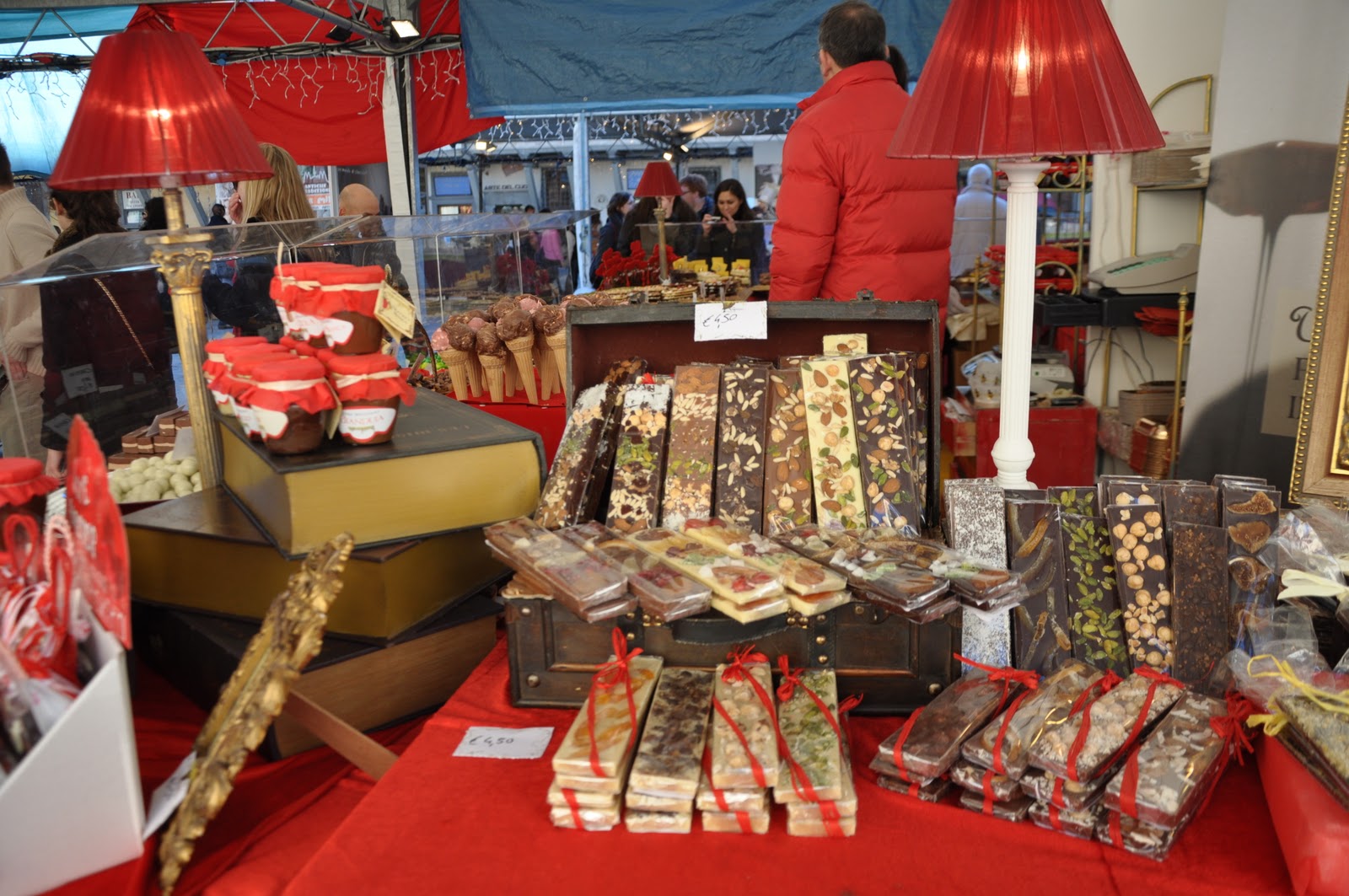
This is a hodge-podge posting of some of the things I've noticed in Florence recently. We are nearing the end of the Chocolate (Cioccolata) Festival.  It is so strange to look out the windows (large casement windows with rounded tops and ancient latches) onto the piazza and see all the tents and people milling about.  The boys have overdosed on chocolate! They just walked outside the door to get warm nutella crepes.  I think my favorite samples were the violet and cinnamon chocolate.  We loved seeing the trumpeters, flag throwers/wavers and drummers on Saturday in the piazza…some tradition I’ve yet to know the history of. 


Cloisters at San Lorenzo

Laurentian Library at San Lorenzo designed by Michelangelo.  Virgil's Aeneid was originally stored here.

Staircase designed by Michelangelo in the Ricetto (vestibule) to Laurentian library.  It's a bizarre staircase--in the fashion of Mannerism.  The stone is pietra serena.

Michelangelo's Ricetto (vestibule into the Laurentian library at San Lorenzo where the Medici stored their ancient texts)

Morgante, the "Court Dwarf" to Cosimo I Medici (in Boboli Gardens).  The turtle was one of Cosimo's favorites: "Festina lente" =more haste, less speed.  The position of court dwarf was one that was offered by all the important rulers in Europe...as they were ascribed to be lucky charms or healers and collected like other exotic objects.  Over the top, no? 


View of Palazzo Vecchio (the original city council building started in 1299) and made of "pietra forta" (strong stone).  This is viewed from a an upstairs patio at the Uffizi Museum where the railings are made of "pietra serena"
The older buildings in Florence were made of pietra forta and the newer in pietra serena.

Merry-go-round in Piazza Repubblica.  For the record, the piazza was empty on this cold day.  It will be a mob scene here in a few months.

Courtyard of Palazzio Vecchio (old city council building) built in 1400s in Piazza Signoria

Sculpture in Bardini Gardens


I started an intensive Italian language course at the Michelangelo Institute about a five minute walk from the apartment.  It is on via Ghibellina very close to the original Buonarotti house (Michelangelo’s home…he was a stone’s throw from Santa Croce piazza) which is now a small museum.  In any event, I am finishing my second week of the course which runs from 9 a.m. to 1 p.m. each day.  It is spoken almost entirely in Italian: seeing as there are three young women from Guatemala, a young man from China (who speaks only Chinese!), a Swedish man and me!  So, you can’t really explain things in English when the others don’t speak it—everything pretty much has to be in Italian and it’s quite lively.   The Guatemalan girls (just out of high school) keep saying “ciao, brother” to the instructor as his name is Hermano!  Idioms are flying everywhere. Because I hear the language spoken around me constantly (you can imagine doing yoga classes in Italian in a 14th century building...at least I understand the Sanskrit), I have begun to understand bits of it but it is still very hard to speak it and parse it into phrases…thus I decided to take the course since it is mostly all conversational.  After taking the first two weeks straight of the intensive, you can continue to add on weeks up to four months.  Not sure I want to take that much…my brain is hurting right now.
Did I mention bureaucracy here?  The boys have been traveling on the bus using a student bus ticket this month and they were tagged by the “ATAF militia” on the bus the other day for not having a proper student ID validating their “student-hood” even though they showed copies of their passports (nest time don't show the passport, boys...)…the fine was 55 Euros apiece.  I spent quite awhile in the post office trying to pay that one off and it was quite comical my trying to fill out the necessary forms before paying.  People go to the post office to pay their bills here and it is rather a complicated affair with four different types of cashiers and numbers you pull to wait in the queue.  I was told that I had to make sure to pay these things off…if not, you are not only fined 7 euros a day but they may tag you when you try to leave the country. That said, I shouldn’t complain.  There are little cameras everywhere and places you can and cannot go with a car unless you are a resident.  The tickets arrive in the mail long after your infractions.  The other day I heard about a woman who didn’t know that you couldn’t drive on one side of the Arno if you lived on the other side and after six months, she had accrued about 5000 Euros in fines! Today I spoke to a woman who has been here since September and just starting receiving her tickets: 500 Euros thus far! I am so glad not to have a car here.
I have talked about paradoxes here but have decided I will start a list.  Just a few: the street sweepers are out every morning cleaning the piazza and streets.  Shopkeepers are always sweeping in front of the shops.  Yet, no one ever cleans up after dog poop—it is smeared everywhere!   You will see the traffic guard stopping car traffic for children to cross a street but the motorbikes will buzz right around the cars and almost take the children out!  And so on…
Santa Croce district  (we are on Piazza Santa Croce) was originally home to one of the guilds for leather making and even the Franciscans at Santa Croce church did leatherwork. There is still a leather school right here and many shops with leather goods produced right here: gloves, boots, coats, etc.  It seems there is leather everywhere. I was in a shop the other day and met the owner who is originally Greek and trained as an architect but who came here to Florence to learn leatherworking 35 years ago and has remained: he now designs coats and writes Greek poetry!  He said that he has decided “life it too short to not live beautifully!”  We should all live by that adage.
There is a gray sandstone called “pietra serena” that has been cut from the hills near Florence and has been used in much of the architecture here: it is around the door frames in our apartment (from the 15th century), it was used on the exterior of the Uffizi, and in Brunelleschi’s  beautiful and elegant work on the inside of San Lorenzo church (by the way, inside the old sacristy of San Lorenzo, last week I saw a tondi (round relief) by Donatello of St. Lawrence holding the real grill on which he was martyred!).  I saw some men re-paving a street with pietra serena the other day.  You walk in these old buildings in winter and the stone seems to retain all the cold and moisture…it is colder inside sometimes than outside.  The original stone here that was used for building was the “pietra forta” (strong stone) and it makes up the outside of many of the older buildings like the Palazzio Vecchio (see below), Barghello, and the old Palazzos like the Medici Palace and the Strozzi Palace (see examples below).  The old part of the city seems like it is a coffin of stone.  As we are right in Michelangelo’s neighborhood, I have been reading the historical fiction “The Agony and the Ecstasy,” about Michelangelo’s life and never realized that his wet nurse was a stonecutter’s wife and he lived out in the Florentine countryside his early years playing around the stone.  No surprise with all the natural stone and marble here that sculptors were "born" here. 


Saturday, February 5, 2011

Rduff's Second Post

Febuary 5th, 2011...Rduff's 2nd post

Dur be a chocolate festival right here in Santa Croce. Italian chocolate is good. There's a bunch of crazy stuff here, like candy with alcohol, and every fruit imaginable dipped in chocolate...this is a view of the festival from our apartment window:
My mom and I went to the University of Florence's "La Specola" Museum of Zoology today that had a bunch of animal models and wax anatomy models of bodies from the 1700s. It was a huge museum, and I was pretty impressed. They had specimens of most animals. The animal below is a rhino.

There is this cool parade thing that they're doing outside around the chocolate festival. It's trumpet and drum players with some knights and a bunch of guys doing flag tricks, as you can see below. You can't really see, but on each flag there is Florence's symbol. That symbol is everywhere in the city. I guess they like bragging!
..they're still playing outside...it never stops!


So other than that stuff, we're still getting used to Florence. I'm starting to like the school a little bit more. I would say that I know my way around the city pretty well now. I could get home from most parts of the city...One thing I'm pretty annoyed about is the fact that it has snowed 4 days in a row in Dallas. I wish I wasn't missing that..Oh well, hopefully it snows here, which it has not yet.


My birthday is in 10 days, so I'm excited for that too

Sunday, January 30, 2011

churches: Siena and Florence.

view of Siena's cathedral from above

It is raining steadily today and Evan is recovering from a bad cold so there’s time for a long post!  We're just sitting around eating lots of blood oranges, which are in season right now, and the basis for a citrus addiction! Last Saturday, the boys and I took the train to Siena, about an hour and a half south of here.   Siena was on the "holy road" to Rome and Florence was not--churches on the holy road profited from the pilgrims making donations during their pilgrimages as you will see in the pictures below of Siena's cathedral. Siena is a medieval city that was always in competition with Florence until it was suppressed in the 1500s by Florence. Thus, the medieval portion of the city is pretty much intact from that time on.  It was a very cold day so we decided to stay for the afternoon, walking the mile from the train station to the medieval part of the city.  It has a huge square in its center called Il Campo where the famous Palio bareback horse races are still held to this day.  We climbed the 500 steps to the Torre del Mangia (the first watchman was an "eater of profits" and thus the name!), visited the beautiful Sienna Duomo and walked around the city a bit until we were frozen and Ryan found us a taxi to get back to the train station! 
  
Palazzo Publicco and Torre del Mangia (Siena)


view of Siena and Tuscan countryside from Tower of Mangia

Another view of Siena and countryside from tower


Siena's Duomo
 

up close, filigree work on Siena's Duomo

Ryan and Evan at top of Torre del Mangia

Okay, if you're still interested in churches, I have some pictures (below) and info to share from my tour of Florence's Duomo the other day with the art history class.  (The boys say they're sick of visiting churches!) Both of these cities had Baptisteries (for baptizing their entire populations) and these were separate from the cathedrals and octogonal.  8 was an auspicious number, indicating infinity (especially when placed on its side!) but also because it represented 7+1, that is it symbolized the eighth day of creation or eternity. Florence's Baptistery was built in two stages, the first part including the first two stories and then the third story was added later and you can see this difference reflected below.  It is a beautiful building and it was built over the site of an old "domis" or home from the Roman times.  The Florentines simply built up the piazza and put the Baptistery and church above.  We went underground below the Baptistery and saw the original mosaic tile floor remains of the house that was there in Roman times as well as some of its walls.  The church that accompanies the Baptistery is called Santa Marie del Fiore, St. Mary of the Flower, and it was built directly over Santa Reparata, the original church on the site.  St. Reparata was Florence's original patron saint, but she was really a "second-rate saint" (you know, only an eleven year old martyr) and so the Florentines decided to name St. John the Baptist as their patron saint to garner a little more respect.  Below you will also see a picture of a memorial to St. Zenobius, Florence's first bishop, just outside the Baptistery.  The day we were there, it was decked with all kinds of fresh flowers to commemorate St. Zenobius...legend has it that there was an elm tree on that site in antiquity, and when St. Zenobius corpse was carried past it, it spontaneously burst into bloom! 
At any rate, I am fascinated by how legends, myths, politics and competition all intertwine in the building of churches and are reflected in the symbolism within. Inside all of these churches are chapels and statues, etc. commissioned by wealthy families to establish their perpetuity, or some type of everlasting fame, and there is competition here as well for bigger and better.  Seems like we do that with our homes now, not so much our churches!  Inside of Santa Maria del Fiore are large paintings of some of their condotterie (mercenaries, in this case from England) who fought for Florence (Again, I love all the contradictions).  We stood inside Santa Maria del Fiore right on the site where the Pazzi conspiracy occured: the Pazzi family decided to take out the Medicis and while Florence's bishop (who was in on the conspiracy as was the Pope at the time) was delivering communion to Lorenzo the Great and his brother, the Pazzis stabbed Lorenzo's brother and killed him right on the spot.  Lorenzo ran into the sacristy of the church and barricaded himself there until help arrived.  Now, that would have been a much less boring lesson than the ones I learned in catechism class!
We had the opportunity to go up on the outside railing of the church (it has a rather low railing I might add) and view the city and Brunelleschi's Dome close-up.  Brunelleschi's Dome was an architectural marvel at the time and still is, since it was the first dome of its type built with flying scaffolding (usually the dome would have to be built over some type of support which would later be removed).  They still don't know exactly how it was done and Brunelleschi never revealed his plans....he didn't write backwards and upside down and cryptically like Leonardo da Vinci, he just didn't keep his plans. As an aside, Fred and I have read Ross King's book "Brunelleschi's Dome" and it is a fascinating account of the building of the dome and the politics and history of the time. We were also able to go inside on the inside upper railing of the church and had some stunning views from above.  Elaine Ruffolo seems to have an "in" with the museums and churches and this has enabled us to do some things you wouldn't do on a normal tour.
I also wanted to mention something about the campanile (bell tower) that accompanies the churches.  Many of these ring at odd times in the city and this still reflects their original purpose--to indicate when the gates to the city were opening in the morning and also to reflect the "working day"--thus, they are still calibrated every few days so they ring at sunset and every hour before sunset for that given day.  You will also see below an original 24 hour clock on the back upper wall of the church. Just across from the Baptistery is a building called the Miseracordia ( a place to "help people") with a fresco of St. Peter preaching to the Florentines to give alms to the poor.  Ironically, it was closed just three weeks ago because of a scandal--there is a great deal of money mysteriously missing from its coffers!
One of the things you can't miss are the Baptistery doors made of gilded bronze.  In 1330, the Florentines celebrated their wealth by commisioning these doors...the first set is by Pisano and they are solid bronze (directly below) and have panels you "read" from left to right of biblical scenes from St. John the Baptist's life.  For the second set of doors, the Florentines held a competition and it boiled down to Brunelleschi (who lost) and Ghiberti who won.  The second set of doors are hollow bronze--there was the revival of the lost wax technique of bronze casting re-discovered from the ancient Roman times.  In any event, the doors are fantastic and there are even little "portraits" of the artists sculpted into the doors!
Though, it is often strange to be "living" in the medieval part of a city, there are some great benefits to being able to go back and forth to these sites at will.  Often times, you can't take all of it in on the first pass.  Yesterday, I braved going into the Uffizi Museum for two hours...there was no line and I was able, for instance, to stand right in front of Botticellis' "Birth of Venus" and actually look at it for awhile...not many people even in that room! The down side to living in a medieval part of a city is that there aren't many trees or greenery, and some of the narrow streets seem like dungeons...just pavement and stone and noises just reverberate off the stone walls.  Today marks 30 days since I have driven a car so that also feels strange since the method of transport is mostly our legs, followed by buses and trains!

Florence's baptistery (St. John) . Notice the gilded bronze baptistery doors


Brunelleschi's Dome on top of Santa Maria del Fiore cathedral (little black holes in the dome are where the flying scaffolding for building the dome went or so it is said.  Inside, the dome, one of the holes comes out right where Christ's head is in the big fresco)

Memorial to St. Zenobius, Florence's first bishop.  When his body was carried by the elm tree that originally grew in this spot, it was said to have flowered spontaneously!


view inside Florence's cathedral from upper inside railing.  Those little blips are people walking around on the magnificent inlaid marble floors.


View of part of dome and city from outside railing of Santa Maria del Fiore

Gilded bronze baptistery doors--each panel has a biblical scene

24 hour clock inside the cathedral


view of the city from the outside railing of Santa Maria del Fiore...you see Santa Maria Novella in distance


Campanile (bell tower) that accompanies Florence's cathedral complex. 

Pictures of famous condotteri (mercenaries!!!) inside Santa Maria del Fiore


Wednesday, January 26, 2011

Cooking post from Renee 1-26-11

I attended a cooking class today at La Quercia Cooking Studio in Impruneta about 15 minutes outside Florence in the country side.  Veronica, the owner and teacher, has a rustic Tuscan kitchen (below) where she teaches cooking classes.  The surrounding property is gorgeous with acres of olive trees and grapevines and Veronica makes her own olive oil "Olio Extravergine di Oliva Toscana Villa La Impruneta" (if that isn't a mouthful!).  She has 27 chickens so has her own fresh eggs for baking souffles. It was an absolute treat just to walk into the kitchen with the fireplace going, the table set already and a large basket on the counter with artichokes, oranges, lemons, and chives...seriously the whole experience almost brought tears to my eyes, it was so other-wordly. 


We spent the day learning how to make the following dishes: a shrimp and white bean antipasto, gnocchi alla Romana, stuffed artichokes, a type of rolled meatloaf called "girello en gallantina", and an orange cream souffle.  My grandmother used to make the most wonderful gnocchis (dumplings) from a potato and wheat flour but the gnocchi all Romana are made solely from wheat (they even have the wheat flour numbered, with the fine 00 type used for gnocchis) and milk with ground nutmeg, then baked covered with some Parmesan and sage butter. I have seen large glass flasks in the windows of cooking stores (of which there are many in Florence!) and had no idea what they were for.  I learned today they are for cooking beans--as Veronica says you must use these flasks with the narrow necks as opposed to a large pan because the beans will "cook like a dance!"  She gave a dissertation on the difference between the four types of artichokes--I had no idea!

I can honestly say that cooking is approached as an art form here, and I understand how the "slow food" movement started in Italy.  You go outside into the herb garden and gather the herbs: everything is gathered fresh.  Often times, before a cooking class, the teacher will take the students to one of the outdoor markets to show them how to buy the ingredients.  We started about 11 a.m. and sat down for this incredible meal a few hours later just as I found out the bus drivers in Florence were on strike and the boys were again walking home from school.  No problem, a little Moscana after this sumptuous lunch...I calculate that I walked about 8 miles total today so I wasn't too worried about what I'd eaten!

La Quercia Cooking Studio

Antipasto di gamberi e fagioli
(antipasto with shrimp and beans)--the shrimp are marinated in fresh orange juice, olive oil, salt and pepper after boiling three minutes


olive trees on the hillside in Impruneta

her olive trees (even in winter you have these wonderful shades of green on the hillsides)


Left: Carcioffi Ritti Scazzottatti (stuffed artichokes)
Right: Girello gallantina ("rolled" type of meatloaf with pistachios and eggs


Veronica in La Quercia Studio teaching